
 <外部リンク>
 <外部リンク>
- Top
-
What is the "Sado Island Gold Mines"?
- What is the "Sado Island Gold Mines"?
- Nishimikawa Placer Gold Mine
- Tsurushi Silver Mine
- Aikawa Gold and Silver Mine
- Traditional Unmechanized Mining Technologies
- A Series of Production Processes from Ore Mining to Koban Gold Coin Minting
- Gold Production System under the Strategic Management by the Tokugawa Shogunate -Transition of Settlement Structure-
- Culture Nurtured in the Mining Community, Life Centered on Mining:
-
What is World Heritage?
- Preservation and Utilization Network
current location
Top
>
What is the “Sado Island Gold Mines”? > Traditional Unmechanized Mining Technologies >
Traditional Unmechanized Mining Technologies
Main content
Page number:0807195
Update date:2026年3月24日更新
The “Sado Island Gold Mines” consists of two areas with different types of deposits: the Nishimikawa Placer Gold Mine and the Aikawa-Tsurushi Gold and Silver Mine, each of which was introduced and developed technologies suited to their different characteristics.
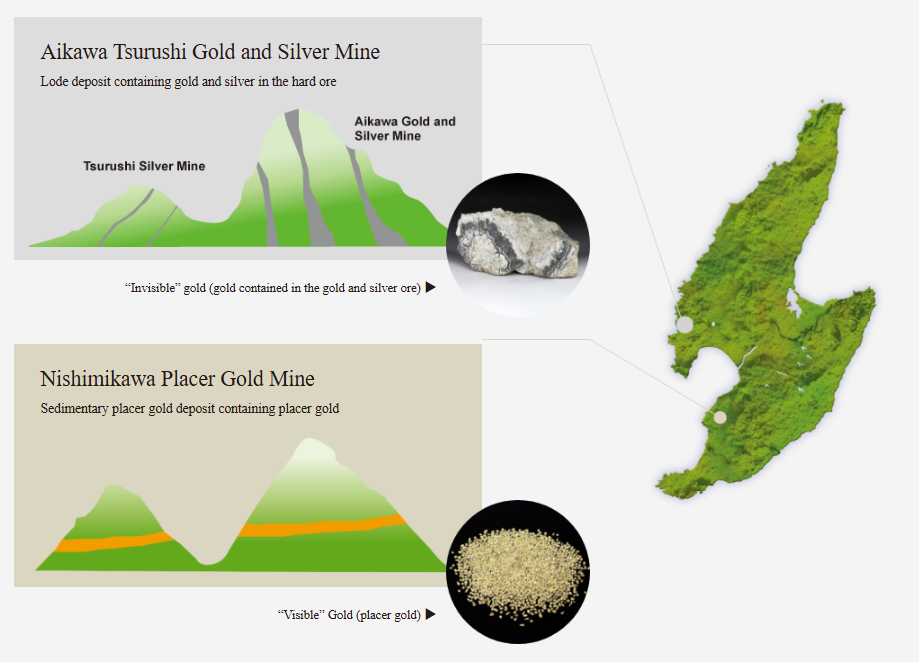
The Nishimikawa Placer Gold Mine:Placer Gold Deposits - Unique Placer Gold Mining Method
The Nishimikawa Placer Gold Mine, known as the oldest producer of gold on Sado, is characterized by its unique deposits called “sedimentary placer gold deposits”, where placer gold is contained in strata. To obtain placer gold, it was necessary to scrape soil including placer gold off the strata of the mountainside and to remove unwanted sand gravel.
For this purpose, a specific mining method called “Onagashi” (great flow) was employed for mining and smelting of gold. This method used the characteristics of gold, which is heavier than any other substance, and water force, leaving the heavy gold at the bottom of the waterway.
- Construct a waterway at the foot of the mountain.
- Scrape soil containing placer gold off the strata of the mountainside and gather it in the waterway.
- Store water drawn through the headrace in a reservoir, and release bursts of water to wash away the scraped soil.
- Collect placer gold that sinks at the bottom of the waterway.
A series of features showing how “Onagashi” was conducted remain on the site: a “headrace” (drawing water from water source), b “reservoir” (storing water), c “race” (leading water to the mining site), d “mining site” (where soil was scraped off the strata), and e “tail race” (washing away unwanted sand gravel).
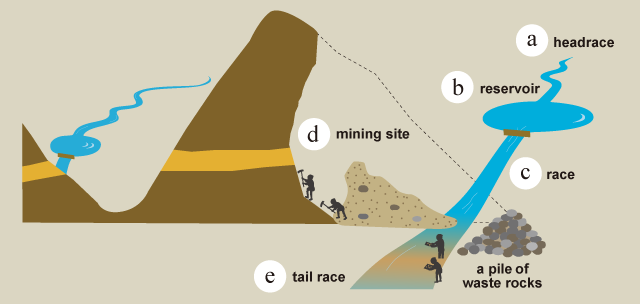
Onagashi Placer Gold Mining Method
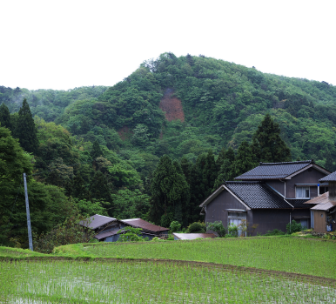
The largest Mining Site:Toramaru-yama Site
Photo by Nishiyama Hoichi
The Aikawa-Tsurushi Gold and Silver Mine:Lode deposits - Large-scale Mining and Technological Improvement
In the Aikawa-Tsurushi Gold and Silver Mine, hard-rock deposits were excavated to obtain ore containing gold and silver. It can be seen that as the size and distribution of deposits changed after a certain number of mines were developed, mining activities shifted from Tsurushi to Aikawa while the scale of excavation grew larger.
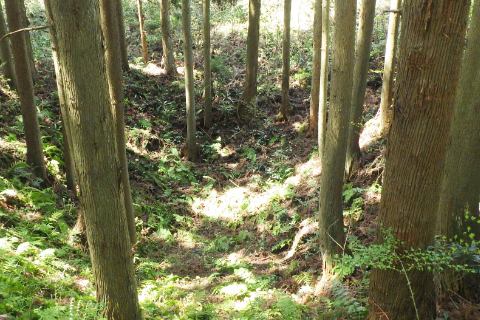
Small-scale Mining Site in early Stage (Tsurushi Silver Mine)
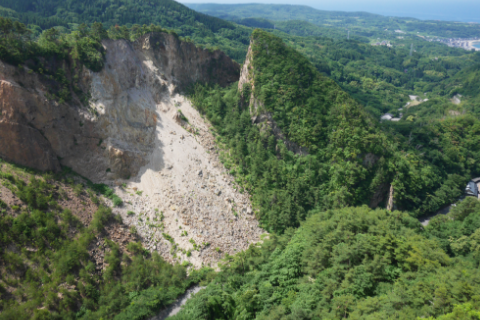
Large-scale Mining Site (Aikawa Gold and Silver Mine)
In the Tsurushi Silver Mine, remains of different mining methods were well retained, illustrating the transition: from “surface mining” and “chase mining” to “tunnel mining.”
Surface mining
Mining an outcropping of veins on the surface with soil and stone around them
Chase mining
Mining by following veins that appear on the ground’s surface
Tunnel mining
Digging horizontal tunnels from the middle or the foot of the mountain to excavate deposits underground, enabling concurrent excavation of multiple veins.
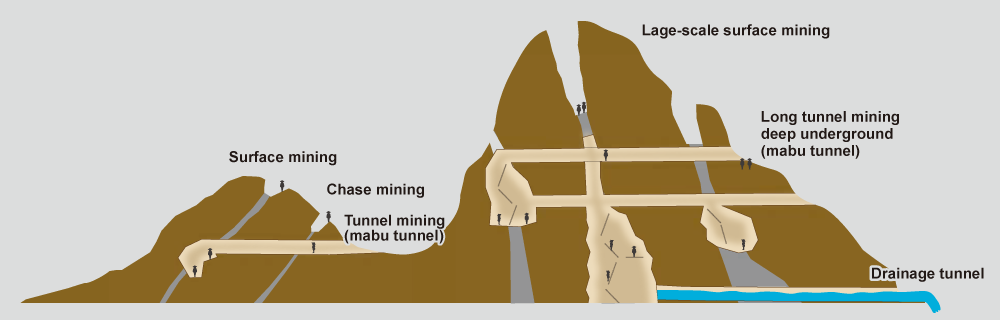
Lode Deposit and Mining Methods in the Aikawa-Tsurushi Gold and Silver Mine
Since deposits in the Aikawa Gold and Silver Mine were larger extending deeper underground than those in the Tsurushi Silver Mine, mining operation was implemented on a large scale with long, deep tunnels. Deep excavation cause issues such as drainage and ventilation, and they were dealt with using complex excavation technologies, resulting in the development of a drainage tunnel (Minamizawa Drainage Tunnel) and a ventilation tunnel (Ogiriyama-mabu Tunnel).
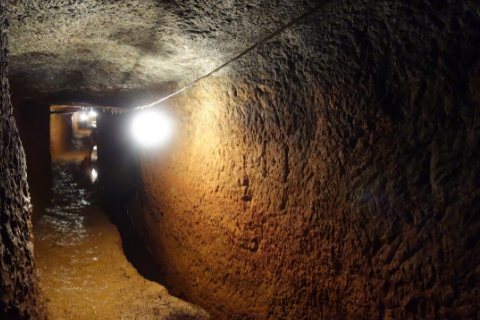
Minamizawa Drainage Tunnel Site
The tunnel was dug by hand over five years to drain groundwater flowing into the tunnel. It is about 1 km long and was excavated simultaneously from six points using a method called “Muakaebori.” The fact that it was completed with minimal error demonstrates the advanced surveying techniques of the time.
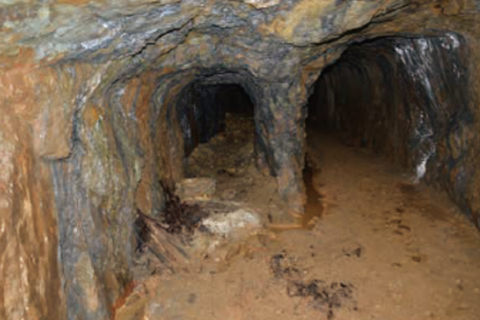
Ogiriyama-mabu Tunnel Site
This site features a ventilation tunnel running parallel to the main tunnel for gold excavation. By connecting the two tunnels partially at several points, the airflow within the tunnel was improved.

 <外部リンク>
 <外部リンク>
 <外部リンク>
 <外部リンク>
 <外部リンク>
 <外部リンク>
 <外部リンク>



4-1 Shinko-cho, Chuo-ku, Niigata 950-8570
Tel+81-25-280-5726
Copyright © Niigata Prefectural Government. All Rights Reserved.