
 <外部リンク>
 <外部リンク>
- Top
-
What is the "Sado Island Gold Mines"?
- What is the "Sado Island Gold Mines"?
- Nishimikawa Placer Gold Mine
- Tsurushi Silver Mine
- Aikawa Gold and Silver Mine
- Traditional Unmechanized Mining Technologies
- A Series of Production Processes from Ore Mining to Koban Gold Coin Minting
- Gold Production System under the Strategic Management by the Tokugawa Shogunate -Transition of Settlement Structure-
- Culture Nurtured in the Mining Community, Life Centered on Mining:
-
What is World Heritage?
- Preservation and Utilization Network
current location
Top
>
What is the “Sado Island Gold Mines”? > Gold Production System under the Strategic Management by the Tokugawa Shogunate >
Gold Production System under the Strategic Management by the Tokugawa Shogunate -Transition of Settlement Structure-
Main content
Page number:0807191
Update date:2026年3月24日更新
Mines in the Nishimikawa area and the Aikawa-Tsurushi area feature two different types of deposits – placer gold at Nishimikawa and lode deposits at Aikawa-Tsurushi. In order to obtain gold from each deposit efficiently, the best-suited production organization was formed in each mining area. This can be seen from the remains related to mine management found on site. This is also understood by the differences and changes in settlement structure of the people who were engaged in mining activities.
Settlement structures
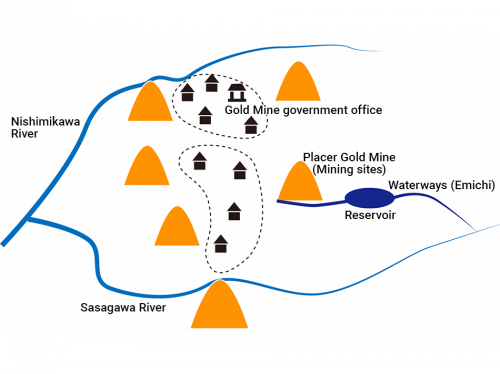
Sasagawa Settlement, Nishimikawa Placer Gold Mine
At the Nishimikawa Placer Gold Mine, mining and ore-dressing were conducted by the unique method called “Onagashi” (great flow), utilizing the force of water and the heavy weight of gold. Workers in each group lived near the mine and formed settlements, forming settlements. The technique of the “Onagashi” and the structure of the settlement did not change significantly throughout the Edo period (1603-1868). Some of its features remain in the irregular lot shapes and building layouts.
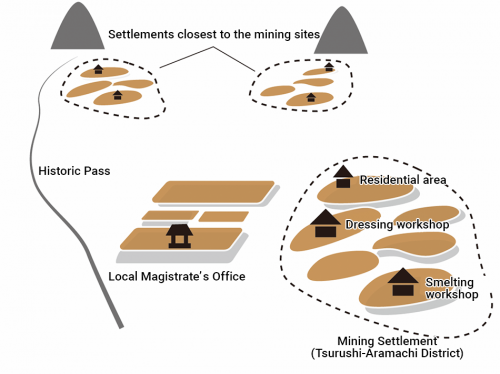
Tsurushi-Aramachi District, Tsurushi Silver Mine
The Tsurushi Silver Mine was the first site of ore deposit mining on Sado.
The Tsurushi Local Magistrate’s Office, which managed the mine, was built on a slope nearby. It has been confirmed that ore dressing and smelting work were carried out through division of labor in the surrounding area. Settlements were formed near the Local Magistrate’s Office and workshops, and residential areas gradually expanded to accommodate the rapidly increasing population brought about by the prosperity of the silver mines. This is evident from randomly connected, irregularly shaped terraces and the absence of main streets within the settlement.
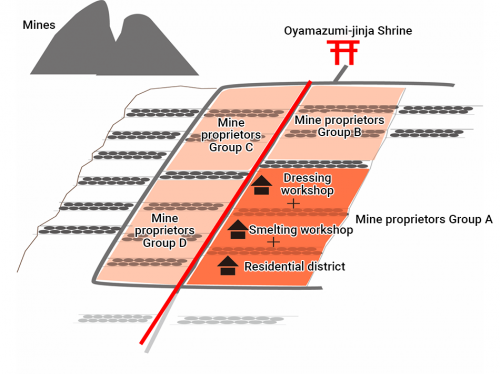
Kami-Aikawa District, Aikawa Gold and Silver Mine
The Kami-Aikawa District was formed in the initial stage of mining activities in the Aikawa Gold and Silver Mine. It had a planned street with rectangular strip-shaped lots on both sides of it. In the drawing map from the Edo period were depicted many towns named after proprietors, or mine managers. They employed many mine workers and produced gold and silver.
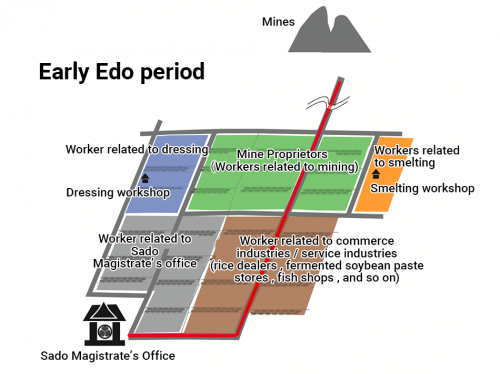
Aikawa-Kamimachi Town, Aikawa Gold and Silver Mine
(Early Edo period: from the 16th century to the 17th century)
The settlement structure of the Aikawa Gold and Silver Mine changed in response to shifts in technical systems and production organization under the strategic management of the Sado Magistrate’s Office.
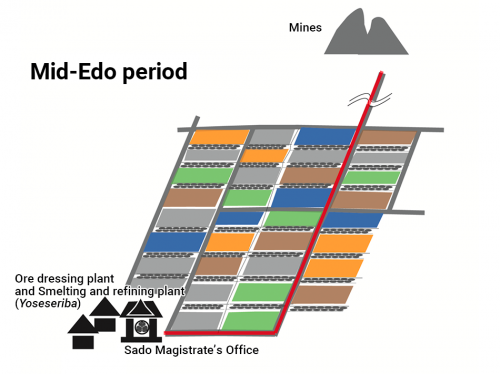
At the beginning of the 17th century, the Sado Magistrate’s Office was established on the edge of the plateau, and the main road connecting the Magistrate’s Office with the mine (the red line in the diagram on the right) was constructed. Centered around the main road, the town was zoned with streets and each zone was assigned by occupation type. This zoning still remains without any major change.
Aikawa-Kamimachi Town, Aikawa Gold and Silver Mine
(Mid-Edo period: 18th century)
Later, scattered workshops for gold and silver production were integrated and consolidated into the plant in the Magistrate’s Office area, and the gold production organization under the direct control of the Magistrate’s Office was established. This made locations of samurai residences switched with those of workshops in the18th century. In this way, the zoning by job function has changed to a mixed occupational town.

 <外部リンク>
 <外部リンク>
 <外部リンク>
 <外部リンク>
 <外部リンク>
 <外部リンク>
 <外部リンク>



4-1 Shinko-cho, Chuo-ku, Niigata 950-8570
Tel+81-25-280-5726
Copyright © Niigata Prefectural Government. All Rights Reserved.